



















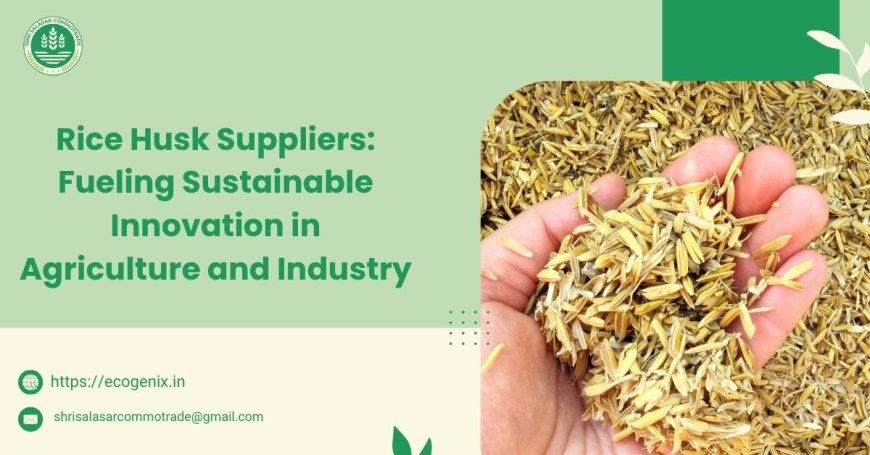
Rice Husk Suppliers: Fueling Sustainable Innovation in Agriculture and Industry
rice husk is now being rediscovered for its enormous industrial and environmental value. But behind this innovation is a critical link in the chain of rice husk supplier.

Introduction
As the world searches for sustainable solutions to meet the growing demands of agriculture, construction, and energy, one material is rising in prominence: rice husk. Often considered an agricultural waste, rice husk is now being rediscovered for its enormous industrial and environmental value. But behind this innovation is a critical link in the chain of rice husk supplier.
What is Rice Husk?
Rice husk (also known as paddy husk) is the hard protective outer shell of the rice grain, removed during the milling process. For every 1000 kg of rice, roughly 200-250 kg of rice husk is generated.
Earlier discarded or burned as waste, rice husk is now being valued for its high silica content, low cost, renewability, and various industrial applications.
Why Rice Husk Matters Today
The global shift toward eco-friendly products and sustainable raw materials has made rice husk a high-demand commodity. It is being used in:
-
Biomass energy production
-
Animal bedding and feed
-
Particleboard and building material
-
Fertilizer and soil conditioner
-
Packaging industry
-
Silica and activated carbon production
This transformation is only possible due to reliable rice husk suppliers who bridge the gap between producers and industries.
Profile of a Modern Rice Husk Supplier
A modern rice husk supplier is no longer a simple collector of by-products. They are now key players in the circular economy, offering:
-
Consistent bulk supply
-
Moisture-controlled and graded husk
-
Logistics and bulk delivery
-
Customized packaging (loose, baled, pelletized)
-
Certification (for export or food-grade use)
Suppliers operate across local, national, and even international markets, depending on the grade and form of husk they offer.
Types of Rice Husk Offered by Suppliers
Rice husk comes in various forms, depending on how its processed or intended to be used:
Raw Rice Husk
Unprocessed, dry husk collected directly from mills. Used in animal bedding, composting, or basic fuel.
Rice Husk Ash (RHA)
Produced by burning husk at controlled temperatures. Rich in silica and used in cement, refractory bricks, and insulation.
Rice Husk Pellets
Compressed husk is formed into pellets for use as biomass fuel in boilers and industrial furnaces.
Ground Rice Husk Powder
Finely ground form used in plastics, resins, or as a filler in composites.
Each of these forms caters to a different industry, and suppliers must maintain specific processing and quality standards for each.
Industries That Depend on Rice Husk Suppliers
Biomass Energy Plants
Rice husk is an excellent alternative to fossil fuels. Many biomass plants rely on large-scale suppliers for clean, moisture-controlled husk to generate power.
Construction and Cement Industry
Rice husk ash (RHA) is used as a pozzolanic material in concrete, improving durability and reducing cement usage. RHA suppliers are critical in meeting bulk requirements.
Agriculture and Animal Husbandry
Farmers and dairy farms use rice husk as animal bedding or as a soil amendment. Here, the freshness and dust-free quality are crucial.
Chemical and Silica Industry
Industries extract precipitated silica from rice husk ash for use in tires, cosmetics, and paints. Only high-grade, low-carbon RHA is accepted, making trusted suppliers essential.
Packaging and Composite Industry
Ground husk is used in eco-friendly packaging and bio-composites. Uniform particle size and dry content are key specifications.
How Rice Husk Suppliers Ensure Quality
To maintain standards, suppliers must meet several quality benchmarks:
-
Moisture Content: Generally under 12% to ensure it doesnt rot or cause mold.
-
Ash Content: For fuel or silica use.
-
Foreign Matter Removal: Clean husk free from stones, dust, or grain.
-
Particle Size Uniformity: Especially for powder or pellets.
-
Storage and Packing: Waterproof and pest-resistant packaging.
Some suppliers even offer on-site drying, milling, and pelletizing, increasing their value in the supply chain.
Geographical Hotspots for Rice Husk Supply in India
India is one of the worlds largest rice producers, generating over 25 million tons of husk annually. Some of the leading rice husk sourcing states include:
-
Punjab & Haryana Basmati husk (longer, lighter)
-
West Bengal Huge rice production base
-
Uttar Pradesh & Bihar Regular bulk availability
-
Andhra Pradesh & Telangana Coastal export hubs
-
Tamil Nadu & Karnataka Strong demand for fuel and packaging use
Suppliers often set up storage yards or collection hubs near major rice mills and transport hubs for quick distribution.
How to Choose the Right Rice Husk Supplier
For industries relying on rice husk, choosing the right supplier is critical. Key factors include:
Supply Capacity: Does the supplier have access to consistent, bulk quantities? Ideal for regular monthly or seasonal supply.
Quality Assurance: Check for moisture levels, grading, packaging quality, and batch testing records.
Customization: Can the supplier offer husk in powder, pellet, or baled form based on your needs?
Delivery Network: Does the supplier offer transport, loading, and last-mile delivery to your facility?
Certifications: For export or sensitive use (like food contact), FSSAI, ISO, or phytosanitary certifications may be needed.
The Export Potential of Rice Husk
India exports thousands of tons of rice husk and rice husk ash every year to countries like:
-
UAE and Saudi Arabia for animal bedding and boilers
-
Vietnam and Indonesia for biomass fuel
-
Germany, Netherlands for silica extraction
-
Africa for farming and poultry bedding
Reliable exporters must ensure fumigation, documentation, and container-grade packing. Many Indian suppliers are now setting up export-specific operations and forming partnerships with international buyers.
Technological Innovations in the Supply Chain
Some forward-thinking rice husk suppliers are now investing in:
-
Moisture sensors and AI-based grading systems
-
Automated pelletizing units
-
Carbon offset tracking to sell to eco-conscious clients
-
Blockchain-based traceability to show source mill, drying, and transport details
These innovations not only improve quality but also help command better prices and client trust.
Sustainability and Environmental Impact
Choosing rice husk over conventional fuels or fillers is not just economical, its environmentally responsible. Here's why:
-
Reduces landfill waste and open-air burning
-
Replaces non-renewable materials (e.g., coal, plastic filler)
-
Biodegradable and safe for soil
-
Carbon-neutral energy source
Rice husk suppliers play a direct role in reducing agricultural waste pollution and promoting a circular economy.
Note:- Purchase affordable rice husk ash in India
Conclusion
In a world where sustainability meets innovation, rice husk is a shining example of how agricultural waste can become industrial gold. At the heart of this transformation are rice husk suppliers enabling industries to shift from harmful, unsustainable inputs to eco-friendly, versatile materials.
Whether you're a biomass plant, construction company, food packager, or agro-startup, partnering with the right rice husk supplier can unlock cost savings, regulatory benefits, and environmental value.